The Bali
Investment Guide

Why Bali, why the west coast, why Kedungu — and how investing actually works
70%+
Average occupancy, popular areas — year-round
25M
Annual arrivals capacity, Ngurah Rai Airport
BBB
Fitch rating for Indonesia — stable outlook
15 m
Building height limit — growth stays horizontal
2.5–3×
Pererenan land value growth since 2018
Why Bali

A market built on structural demand, not hype

The Indonesian government actively drives foreign-currency inflows through tourism, and Bali’s strict building regulations — no development above 15 metres — mean the island grows horizontally, not vertically. Demand concentrates on land, and land in the path of development keeps repricing.

A worldwide leading destination

Tourist arrivals have grown steadily since the early 2000s, and the expanded Ngurah Rai Airport now handles up to 25 million arrivals annually. Bali is never going out of fashion.

High occupancy, low seasonality

Average occupancy in the popular areas — Canggu, Seminyak, Ubud, Uluwatu — rarely drops below 70%. Rental income flows all year, not just in a short high season.

Low costs, high net returns

Construction and operating costs remain far below comparable resort markets, which is what makes above-average net yields possible in the first place.

A resilient, future-proof market

Bali’s infrastructure for location-independent workers has made it the number-one base for digital nomads — a demand layer that persists even when classic tourism dips.

Rated and recognised

Fitch assigns Indonesia a stable BBB rating. Forbes lists Bali among the top five investment destinations worldwide; U.S. News ranks it 4th for investment attractiveness.

Simple to enter

No Indonesian company required — a valid passport is enough. Deals can be closed remotely via power of attorney, and payouts go to any international bank account.

Why the west coast

Development moves along the coast — in one direction

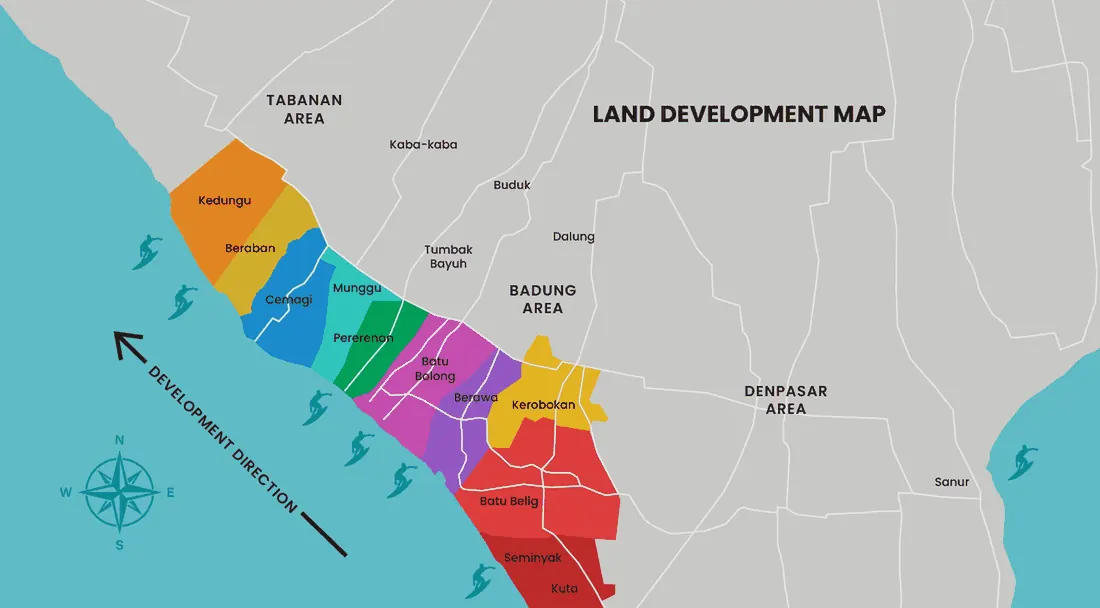
The west coast combines Bali’s best surf, beaches and lifestyle scene with land that is still comparatively undeveloped. As Canggu and Pererenan matured, demand pushed north-west through Cemagi and Seseh. Buying inside that direction of travel — before infrastructure and pricing catch up — is the entire strategy.
2.5–3×
Pererenan land value growth since 2018 (indicative market data)
19–37%
Historical uplift, pre-construction to stabilised market value
Land development map — development direction along Bali's south-west coast toward Kedungu
Development direction, south-west coastKedungu → next phase
Why Kedungu, why now

The next phase is already under construction

Kedungu pairs surfing beaches and tranquil rice-field surroundings with a two-minute ride to beaches, cafés, gyms and restaurants. History on this coast is consistent: areas with surf breaks develop fastest and return most. The signals are already visible on the ground.
  • Upcoming beach club — Potato Head is coming to Kedungu
  • Upcoming international school — anchor for long-stay families
  • Government-supported development — planned as a tourist destination
  • Wide streets, no traffic jams — infrastructure Canggu never had
  • High-net-worth influx — residents and anchor businesses arriving
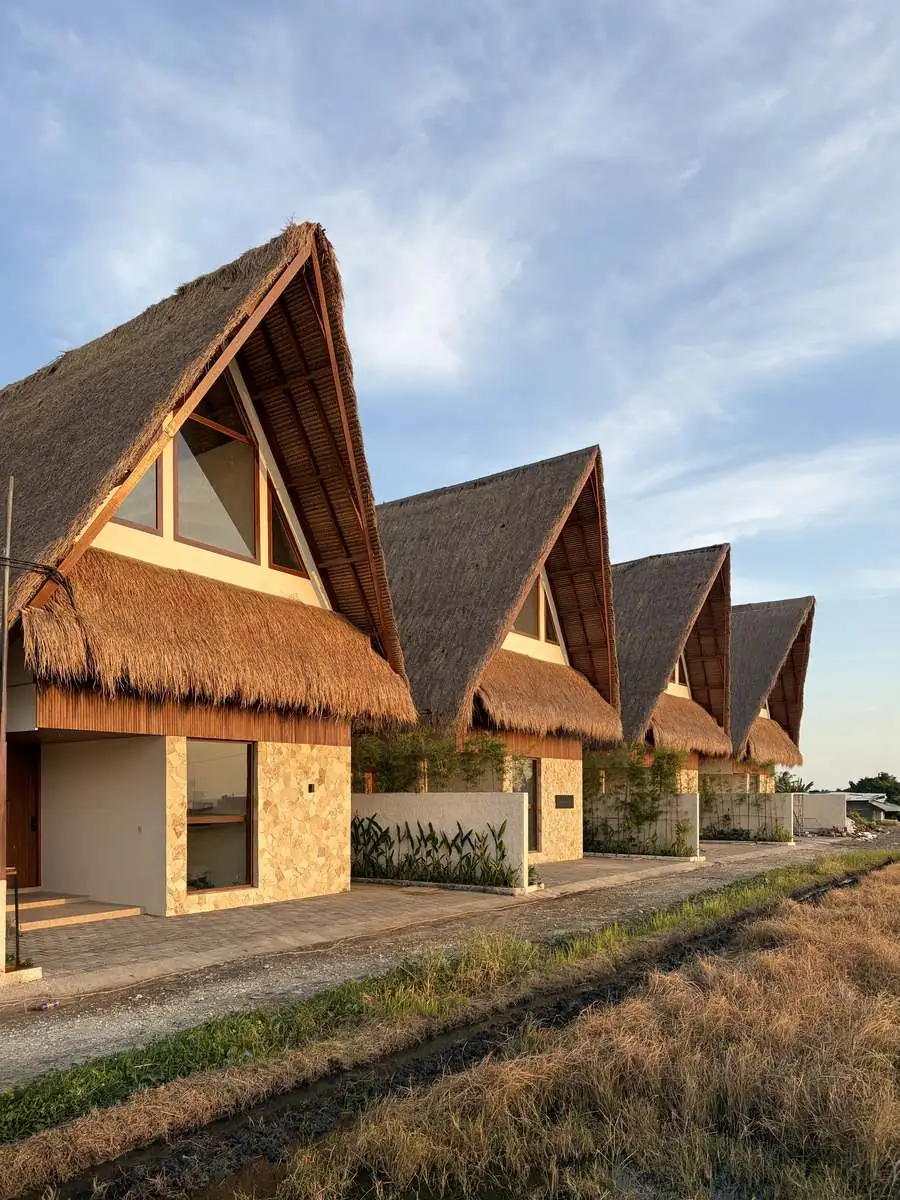
The finished Luxury Huts row in Kedungu at golden hour
The practical part

How investing actually works

Do I need an Indonesian company (PT PMA) to invest?+
No — you only need a valid passport. Your villa is held through a registered leasehold in your name, and our management partner can rent it out on your behalf and pay profits to any international bank account.
Do I need to be in Bali to close the deal?+
No. You either sign the documents in Bali or provide a Power of Attorney (POA) to someone in Bali who signs on your behalf — the entire transaction can be handled remotely.
How are payments structured?+
Through notarised, milestone-based payment plans: a reservation deposit during due diligence, a larger instalment at contract signing, staged payments tied to verified construction progress, and a final retention released at handover. The exact schedule is fixed per project — for Luxury Huts 2.0 it is 5 / 30 / 30 / 30 / 5.
Can I use the villa myself?+
Yes. With our management partner running the villa, you can block personal stays whenever you like and earn rental income the rest of the year.
What does management cost?+
Full property management — Airbnb guest management, maintenance and operational support — is handled by our proven management partner at a 15% commission on rental income. We hand your villa over at the standard we built it to, and they keep it performing.
Talk to a founder

Get advice from the people who build

No sales team, no call centre — you speak directly with the co-founders.

Roman Husemann, Co-Founder of Loa Villas
Co-Founder

Roman Husemann

Investment strategy, project planning and everything about the numbers.

WhatsApp Roman
Dariusch Zadeh, Co-Founder of Loa Villas
Co-Founder

Dariusch Zadeh

Construction, project management and everything about the build.

WhatsApp Dariusch
Ready when you are

See what’s building right now

Our current development in Kedungu — Luxury Huts 2.0, four units, fully documented from yield model to floorplan.